
Las Vegas Motorcycle Accident Lawyer
Injured on a Motorcycle?
Your Case Should Be Judged by the Evidence. Not Assumptions About Riders.
Injured on a Motorcycle?
Your Case Should Be Judged by the Evidence. Not Assumptions About Riders.

Motorcyclists have very little protection when another vehicle makes a mistake.
A driver who changes lanes without looking, turns across a rider’s path, follows too closely, or fails to notice a motorcycle can cause injuries that change someone’s life in seconds.
Ryan Alexander and his team help injured motorcycle riders throughout Las Vegas investigate what happened, deal with insurance companies, document their losses, and pursue the compensation available under Nevada law.
Why Motorcycle Accident Claims Can Be Different
A motorcycle crash is not simply a car accident involving a smaller vehicle.
Motorcyclists can suffer much more serious injuries from the same impact because there is:
no vehicle frame surrounding the rider
no seat belt
no airbag protection comparable to a passenger vehicle
greater exposure to the roadway and surrounding vehicles
The insurance investigation can also become more complicated.
Drivers may say they never saw the motorcycle.
Insurers may scrutinize speed, lane position, protective equipment, riding experience, prior medical history, and anything else they believe could affect fault or damages.
That makes preserving the evidence particularly important.
What Types of Motorcycle Accidents Do We Handle?
Left-Turn Accidents
A driver turns across the path of an approaching motorcycle because they misjudge its speed, fail to see it, or turn without sufficient clearance.
Unsafe Lane Changes
A vehicle moves into a motorcycle’s lane without checking mirrors or blind spots.
Rear-End Collisions
Even a relatively low-speed rear impact can knock a motorcyclist from the bike and cause serious injuries.
Intersection Crashes
Traffic signals, right-of-way disputes, turning vehicles, and conflicting accounts can make intersection accidents particularly complicated.
Highway Accidents
Crashes on I-15, US-95, I-215, and other Las Vegas-area highways may involve high speeds, several vehicles, and severe injuries.
Distracted Driver
Drivers using phones, navigation systems, or otherwise failing to pay attention may not recognize a motorcycle until it is too late.
Impaired Driver
Alcohol or drug impairment may affect reaction time, judgment, and the ability to safely share the road.
Hit-and-Run
When the responsible driver leaves the scene, other insurance options, including uninsured-motorist coverage, may need to be investigated.
What Evidence Matters After a Motorcycle Crash?
Motorcycle accidents can happen quickly and sometimes leave the motorcycle far from the original point of impact. Evidence may include:
Scene Photographs
Images of the roadway, debris, skid marks, traffic signals, lanes, and vehicle positions.
Motorcycle Damage
Damage patterns can help show the direction and severity of an impact.
Vehicle Damage
The location of damage on the other vehicle may help reconstruct how the collision occurred.
Surveillance and Dashcam Video
Nearby businesses, homes, vehicles, and traffic systems may have recorded the crash.
Witness Statements
Independent witnesses can become especially important when the drivers give different accounts.
Police Documentation
Reports may contain statements, diagrams, traffic citations, witness information, and observations from the scene.
Electronic Evidence
Depending on the case, phone records, vehicle data, GPS information, or other electronic records may become relevant.
What If You Were Partially at Fault?
Do not assume that partial responsibility automatically eliminates your case. Nevada uses comparative negligence.
Under NRS 41.141, an injured plaintiff may still recover when their negligence is not greater than the negligence of the defendant or combined defendants, although the amount recovered can be reduced according to the plaintiff’s percentage of fault. (Nevada Legislative Counsel Bureau)
For example, an insurer might argue that a rider was traveling too fast while the rider maintains that another driver made an unsafe left turn. Those issues may both become part of the liability analysis.
What Compensation May Be Available After a Motorcycle Accident?
Every claim is different.
Recoverable damages may potentially include:

Medical Expenses
Emergency care, hospitalization, surgery, therapy, medication, and other treatment related to the injuries.

Future Medical Care
Serious injuries may require additional procedures, rehabilitation, assistive devices, or long-term treatment.

Lost Income
A rider may be unable to work temporarily while recovering.

Loss of Future Earning Capacity
Permanent injuries may affect the ability to perform a previous occupation or earn income in the future.

Scarring and Disfigurement
Motorcycle crashes can produce permanent visible injuries.

Motorcycle and Property Damage
Repair or replacement of the motorcycle, riding equipment, and other damaged property may need to be addressed.
Other Losses: The recoverable damages depend on the individual facts of the case.
How Much Is a Motorcycle Accident Case Worth?
There is no standard settlement amount.
A motorcycle injury case may be affected by:
severity of the injuries
length and type of medical treatment
permanent impairment
future medical needs
lost wages
reduced earning capacity
scarring
fault
available insurance
quality of the evidence
prior medical conditions
whether litigation becomes necessary
What Insurance Applies to a Motorcycle Accident?
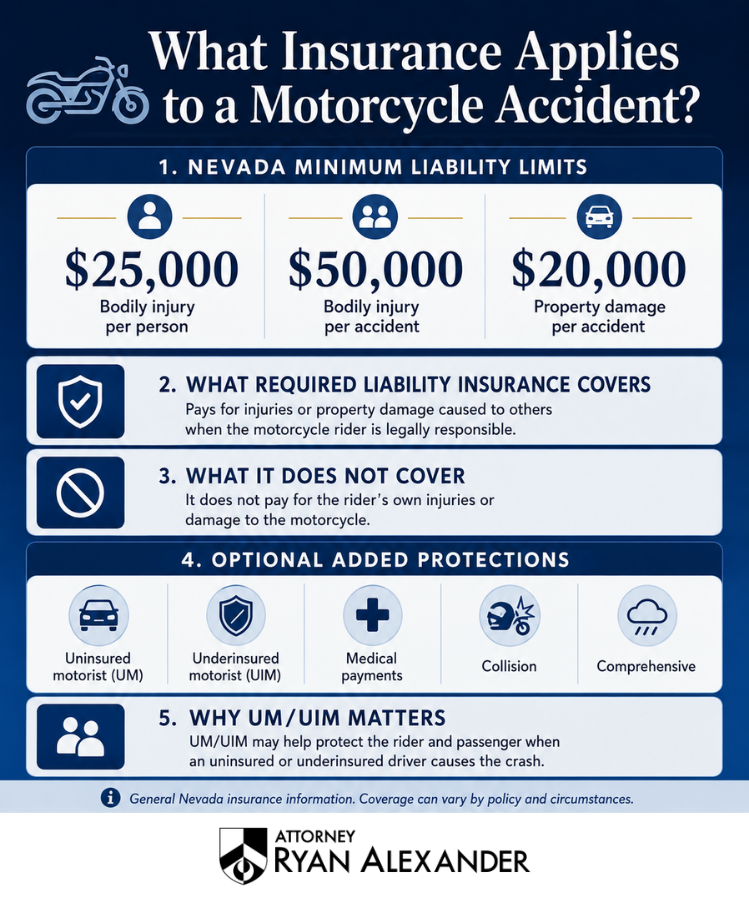
Nevada’s current minimum motor-vehicle liability limits are:
$25,000 bodily injury per person
$50,000 bodily injury per accident
$20,000 property damage per accident
Motorcyclists can also purchase additional protections such as:
uninsured motorist coverage
underinsured motorist coverage
medical payments coverage
collision coverage
comprehensive coverage
The Nevada Division of Insurance specifically notes that UM/UIM coverage may protect a rider and passenger when an uninsured or underinsured driver causes the crash. (Nevada Department of Insurance)
Frequently Asked Questions
Do I have a motorcycle accident case if the driver says they never saw me?
Possibly. A driver’s failure to see a motorcycle does not automatically resolve liability. The circumstances and evidence need to be evaluated.
Does Nevada require motorcycle helmets?
Generally, yes. Nevada law requires motorcycle drivers and passengers on highways to wear approved protective headgear, subject to statutory exceptions. (Nevada Legislature)
Can I recover if I was partly responsible?
Potentially. Nevada comparative-negligence law may allow recovery when your negligence is not greater than the negligence of the defendant or combined defendants.
What if the other driver has no insurance?
Your own uninsured/underinsured motorist coverage may potentially apply if you purchased it.
Does motorcycle insurance cover my own injuries?
Mandatory liability insurance generally pays for injuries or damage you cause to others. Additional coverage such as UM/UIM or MedPay may provide protection for the rider or passenger depending on the policy.
What if my passenger was injured too?
The passenger may have a separate claim depending on who was responsible and what insurance coverage applies.
How much is my motorcycle accident worth?
There is no fixed amount. Injury severity, medical treatment, long-term impact, liability, insurance coverage, and evidence can all affect value.
Do I have to go to court?
Not necessarily. Many claims resolve without trial, but litigation can become necessary when liability or damages remain disputed.
Get In Touch
Email: [email protected]
Office Hours
Mon – Fri: 8:00am – 5:00pm
Sat – Sun: CLOSED
Attorney Ryan Alexander
3017 West Charleston Blvd, Ste 10
Las Vegas, Nevada 89102
Phone Number: (702) 333-8888

Located on W. Charleston Blvd. in Las Vegas, near Rancho Dr.


© 2026 | Attorney Ryan Alexander - All Rights Reserved